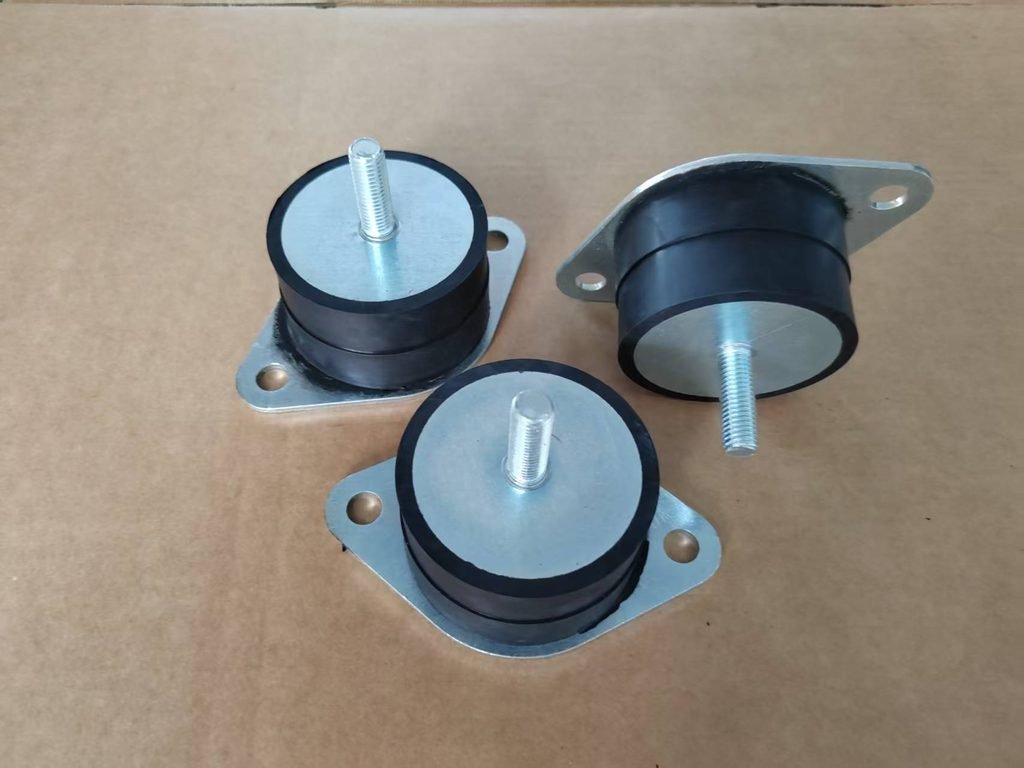
Anti-Vibration Rubber Mounts for Air Compressors
Air compressors are widely used in factories, workshops, construction sites, automotive facilities and industrial production systems. Depending on the compressor design, vibration can be generated by rotating components, reciprocating mechanisms, motors and other moving parts.
Excessive vibration can be transmitted to the floor, supporting frame and surrounding equipment.
Rubber vibration mounts for air compressors provide a practical solution for reducing vibration transmission and absorbing mechanical shock.
Why Do Air Compressors Need Vibration Isolation?
Compressors can generate continuous mechanical vibration during operation.
If the compressor is mounted directly onto a rigid structure, vibration can travel through the supporting structure.
This may result in:
- Increased noise
- Equipment movement
- Mechanical stress
- Fastener loosening
- Premature component wear
- Structural vibration
Rubber anti-vibration mounts create a flexible interface between the compressor and its supporting structure.
How Do Rubber Compressor Mounts Work?
A rubber compressor mount typically combines an elastomeric rubber element with metal components.
The rubber element provides elasticity and damping.
Under the weight and operating forces of the compressor, the rubber deforms and helps absorb vibration energy.
The performance depends on the relationship between:
- Compressor weight
- Mount stiffness
- Rubber hardness
- Operating RPM
- Vibration frequency
- Load distribution
- Mount geometry
Applications for Compressor Rubber Mounts
Rubber vibration mounts can be used with various compressor systems.
Screw Compressors
Rotary screw compressors contain rotating components that can generate vibration.
Proper vibration isolation can help reduce transmission to the supporting floor.
Reciprocating Compressors
Reciprocating compressors can generate significant dynamic forces due to piston movement.
Appropriate vibration isolation is particularly important for equipment with strong reciprocating forces.
Industrial Compressors
Large industrial compressors may require heavy-duty rubber vibration mounts designed according to equipment weight and operating conditions.
Portable Compressors
Portable compressor systems may also use rubber mounts to reduce vibration between the compressor assembly and frame.
How to Select Rubber Mounts for an Air Compressor
Compressor Weight
Determine the total operating weight.
Then calculate the approximate load applied to each mounting point.
Operating RPM
The compressor’s operating speed is an important factor when selecting the mount stiffness.
Dynamic Forces
Reciprocating equipment may generate stronger dynamic forces than some rotating machinery.
The mount must therefore be selected according to the actual operating conditions.
Rubber Hardness
Different rubber hardness levels provide different stiffness and damping characteristics.
The appropriate hardness depends on load and required isolation performance.
Installation Position
The mount’s orientation and mounting configuration can affect its performance.
Always ensure that the mount is installed according to the design requirements.
Rubber Materials for Compressor Mounts
The rubber compound should be selected according to the operating environment.
NBR Rubber
NBR is often considered for applications involving exposure to oils and petroleum-based fluids.
Natural Rubber
Natural rubber offers good elasticity and dynamic fatigue performance.
EPDM Rubber
EPDM offers good resistance to weathering and ozone and can be considered for outdoor applications where its chemical compatibility is appropriate.
Common Problems Caused by Incorrect Mount Selection
Using an unsuitable mount may cause:
Excessive Compression
If the mount is overloaded, the rubber may deform excessively.
Excessive Vibration
If the mount is too stiff or incorrectly selected, vibration isolation may not meet the application requirements.
Premature Rubber Damage
Incorrect rubber material may deteriorate when exposed to oil, fuel, chemicals, heat or other environmental conditions.
Uneven Load Distribution
If the equipment does not distribute its weight evenly, some mounts may be overloaded.
OEM Compressor Rubber Mounts
Compressor manufacturers may require custom rubber vibration mounts for new equipment designs.
Custom solutions can include:
- Special dimensions
- Different rubber hardness
- Custom rubber compound
- Special metal parts
- Different bolt sizes
- Custom load capacity
- OEM packaging
Drawings or samples can be used as the basis for custom development.
Frequently Asked Questions
What are compressor vibration mounts?
Compressor vibration mounts are rubber or elastomeric components designed to isolate vibration between an air compressor and its supporting structure.
Can rubber mounts reduce compressor noise?
They can reduce structure-borne vibration, which may help reduce noise transmitted through the supporting structure.
Which rubber is suitable for compressors?
The material depends on the operating environment. NBR may be suitable where oil resistance is important, while natural rubber or EPDM may be selected for other conditions.
How do I calculate the load per mount?
Start with the total operating weight and mounting-point configuration. Actual load distribution should also consider the equipment’s center of gravity.
Can you manufacture custom compressor mounts?
Yes. Custom rubber compressor mounts can be manufactured according to drawings, samples, dimensions, hardness and load requirements.
Conclusion
Air compressors require effective vibration control to maintain stable operation and reduce vibration transmission.
The correct rubber compressor mounts should be selected according to equipment weight, operating RPM, dynamic forces, rubber hardness, material and working environment.
We provide standard and OEM rubber vibration mounts for compressors, generators, marine equipment, HVAC systems and industrial machinery.
Send us your compressor drawing, dimensions, load requirements or sample to discuss a suitable rubber vibration mount.